THE DRISHTI MASTERY SERIES
Book Two: The Confident Reader
Patterns, Context, and Your First Backtested Edge
Profitma · The Drishti Framework
Disclaimer: This book is for educational purposes only. Nothing in this book constitutes investment advice. All characters, companies, and trading examples are fictional or illustrative. Rohan Mehta is a fictional character. The P&L figures shown are hypothetical and do not represent actual trading results. Past performance does not predict future results. Trading financial instruments carries significant risk of loss. Please consult a SEBI-registered investment adviser before making investment decisions.
"The market does not reward intelligence. It rewards clarity." — The Drishti Framework
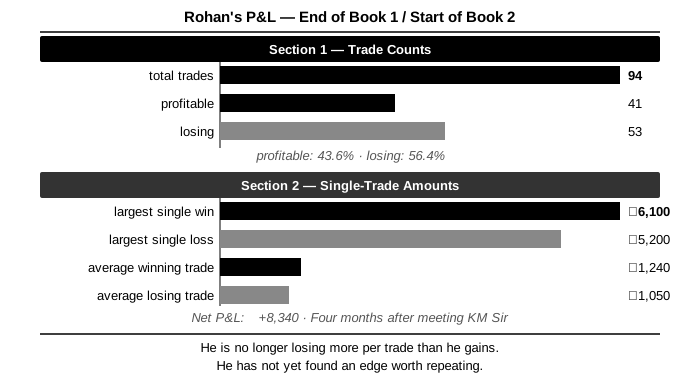
Rohan's P&L — End of Book 1 / Start of Book 2
Total trades (Books 1 period) ...... 94
Profitable trades .................. 41 (43.6%)
Losing trades ...................... 53 (56.4%)
Net P&L ............................ ₹+8,340
Average winning trade .............. ₹1,240
Average losing trade ............... ₹1,050
Largest single loss ................ ₹5,200
Largest single win ................. ₹6,100
Trading period ..................... Four months after meeting KM Sir

He is no longer losing more per trade than he gains.
He has not yet found an edge worth repeating.
Preface
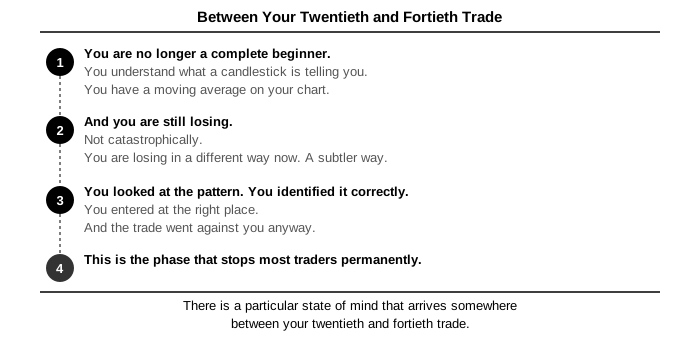
There's a particular state of mind that shows up somewhere between your twentieth and fortieth trade.
You're not a complete beginner anymore. You've learned support and resistance. You understand what a candlestick is telling you. You have a moving average on your chart, and you've more or less learned not to fight the trend. You have a checklist — maybe a rough one, maybe still just in your head — but it's something that looks like a system.
And you're still losing. Not badly. Not the way you lost in your first month, buying tips from Telegram groups and holding through eight-percent declines because selling felt like admitting defeat. You're losing in a different way now. A quieter way. You're losing trades your chart told you would work.
You looked at the pattern. You identified it correctly. You entered at the right place. And the trade went against you anyway.
This is the phase that stops most traders for good.
Traders reach this point after doing everything right — putting in the work, learning the basics, building a first system — only to find the system doesn't work as consistently as the textbooks promised. Patterns fail. Setups that looked identical produce different outcomes. The market, which had started to feel readable, starts to feel random again.
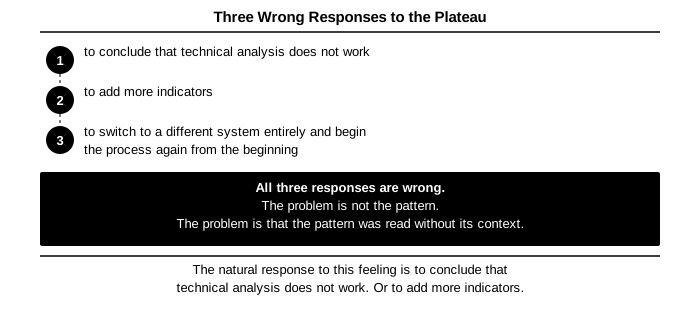
The natural reaction is to decide technical analysis doesn't work. Or to pile on more indicators. Or to switch systems entirely and start over from scratch.
All three reactions are wrong. The problem isn't the pattern. The problem is that the pattern was read without its context.
A hammer candlestick at the bottom of a clean downtrend, near a clear support level, with volume expanding, in a stock from a sector the broader market is rotating into — that's a very different signal from a hammer candlestick appearing mid-consolidation, in a stock that's been going sideways for six weeks with no clear direction.
Both look identical on the chart. Both are technically hammer candles. Only one of them is actually telling you something useful.
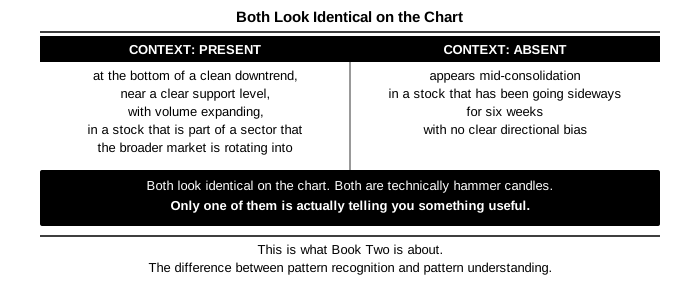
This is what Book Two is about.
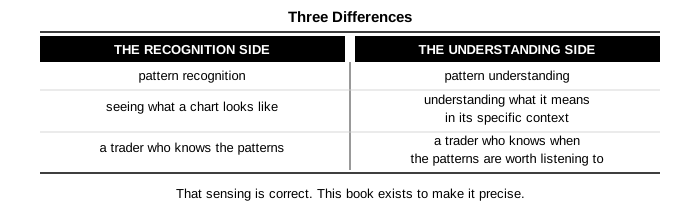
The difference between pattern recognition and pattern understanding. The difference between seeing what a chart looks like and understanding what it means in its specific context. The difference between a trader who knows the patterns and a trader who knows when the patterns are worth listening to.
What You Bring to This Book
If Book One was about building your first system, Book Two is about stress-testing it.
You're assumed to have finished Book One, or to have reached an equivalent understanding through your own trading experience. You know the basics of candlestick reading, support and resistance, moving averages, volume, and trend identification. You've made at least twenty trades with real money. You've seen your system produce wins and losses you can't fully explain.
You're starting to sense there's something beyond the individual pattern — something about condition, context, and timing — that separates the trades that work from the ones that don't.
That instinct is correct. This book exists to make it precise.
What This Book Covers
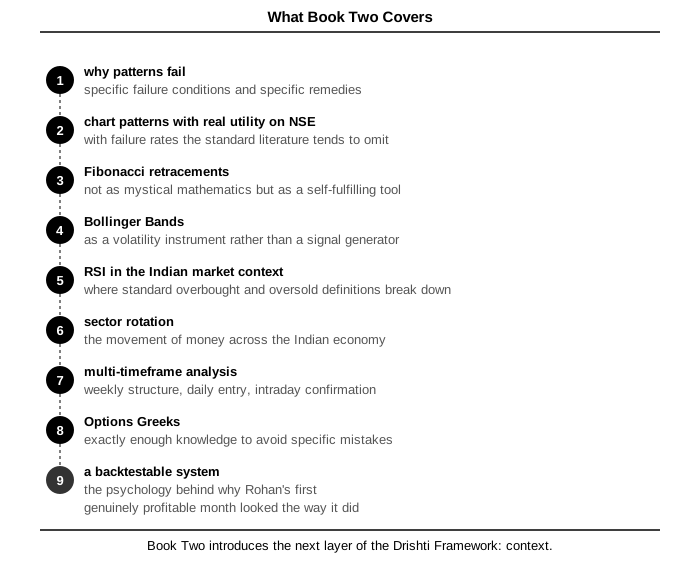
Book Two introduces the next layer of the Drishti Framework: context.
We start with why patterns fail — not as a philosophical question, but a technical one, with specific failure conditions and specific fixes. From there, we move through the chart patterns that have shown real value on the NSE, including the failure rates standard trading literature tends to leave out. We look at Fibonacci retracements not as mystical math but as a self-fulfilling tool — useful precisely because enough traders use it that its levels become real. We look at Bollinger Bands as a volatility instrument rather than a signal generator.
We cover RSI in the Indian market context, where the standard overbought and oversold definitions break down in sustained trends more often than Western textbooks admit. We look at sector rotation — the movement of money across the Indian economy — as the invisible, macro-level context that decides whether individual stock setups play out in your favour or against it.
Multi-timeframe analysis gives us a way to line up context across different time horizons: weekly structure, daily entry, intraday confirmation. Options Greeks gives the chart trader exactly enough knowledge of options mechanics to avoid the specific mistakes that wreck chart-based option positions.
The final two chapters build toward something concrete: a backtestable system, and the psychology behind why Rohan's first genuinely profitable month looked the way it did.
A Note on TradingView
Book One was built around Zerodha Kite and the free tier of TradingView. Book Two assumes you've upgraded to TradingView's paid plan, or are willing to for the length of this book. The reason is simple: several of the tools we cover — multi-timeframe analysis, the backtesting interface, RSI with custom parameters — need features the free tier doesn't offer.
This isn't a promotional recommendation. It's a practical one. The upgrade costs far less than a single trade made without the right tool.
KM Sir's Notebook
At the start of each chapter, KM Sir opens his worn leather notebook and reads a line from it. These aren't motivational quotes. They're observations he's recorded over eleven years of full-time trading — one sentence per trading day, the distilled residue of whatever that day taught him.
They sit at the start of each chapter because, in compressed form, they already contain the core insight the chapter is about to spend its pages unpacking.
Read them slowly. Some will make full sense only at the end of the chapter. A few will make full sense only after you've made the mistake they're warning you about.
That's by design. That's how his notebook works.
The Exercises
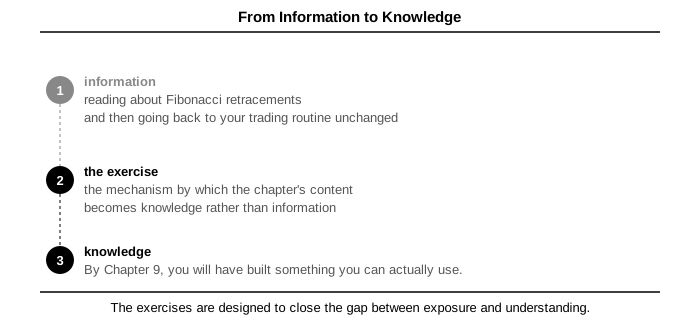
Each chapter ends with a specific exercise. These aren't optional extras. They're how the chapter's content turns from information into actual knowledge.
Reading about Fibonacci retracements and then going back to your trading routine unchanged isn't learning. It's the comfortable feeling of having been exposed to something. The exercises exist to close the gap between exposure and real understanding.
They need a TradingView account, a Zerodha Kite login, and your own trade history. Each one is built to take thirty to ninety minutes. The exercises in later chapters build on the output of the earlier ones.
By Chapter 9, you will have built something you can actually use.
One More Thing
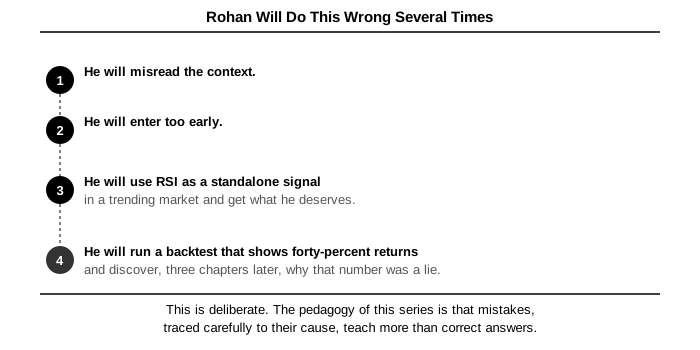
Rohan will get this wrong several times.
He will misread the context. He will enter too early. He will use RSI as a standalone signal in a trending market and get exactly what he deserves. He will run a backtest that shows forty-percent returns and find out, three chapters later, why that number was a lie.
This is deliberate. This series is built on the idea that mistakes, traced carefully back to their cause, teach more than correct answers do.
When Rohan makes an error, pay attention to where it actually happened — not at the level of the specific trade, but at the level of his thinking. What assumption led him into the error? What would have had to be different for him to catch the problem before it cost him money?
Asking that question honestly is the practice this book is trying to build.
Mumbai The Drishti Framework
Book One of the Drishti Mastery Series is available free at profitma.com . If you have not read it, begin there.