Risk Management Before Profit
On a Tuesday in mid-December, Rohan placed a trade that cost him ₹11,400 in forty minutes.
He hadn't followed his system. That's the honest way to start this story.
He had been watching a mid-cap pharmaceutical company for three days. The stock had been rising steadily, and the setup looked clean on the chart. But when he checked his four rules, Rule 2 hadn't triggered: the MACD hadn't crossed yet. It was close. The histogram was narrowing. But the cross hadn't happened.
He entered anyway.
His reasoning, which he'd pick apart later, was that the cross was about to happen and he didn't want to miss the entry. He didn't want to wait for the signal and end up entering at a worse price. He wanted to get ahead of his own system.
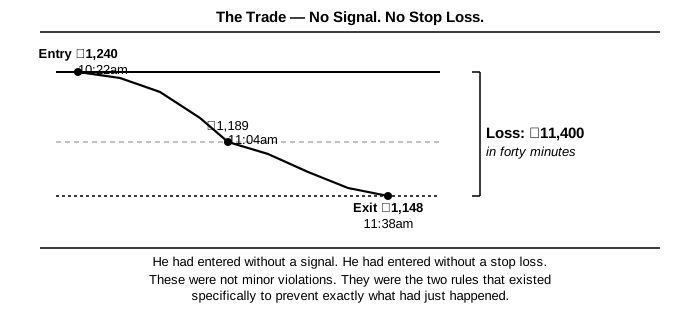
He entered at ₹1,240 at 10:22am. He didn't set a stop loss. His reasoning for that second mistake was that he'd watch the trade and exit manually if it went against him.
By 11:04am the stock was at ₹1,189.
He watched it. He didn't exit. He told himself it was a temporary pullback.
By 11:38am it was at ₹1,148.
He exited at ₹1,148.
Loss: ₹11,400 in forty minutes.
He sat for a while after closing the trade. The market was still open. Other prices kept moving on his screen. He didn't look at them.
He had broken the two most important rules in his system at the same time. He had entered without a signal. He had entered without a stop loss. These weren't small violations. They were the exact two rules built to prevent exactly this: a big loss on a trade taken on a feeling, not a condition.
He had paid ₹40,247 to learn that trading on feelings produces losses. He had spent six weeks building a system meant to replace feelings with conditions. Then he had broken that system the first time his feelings pushed back.
He set his phone screen-down on the desk and stared at the wall.
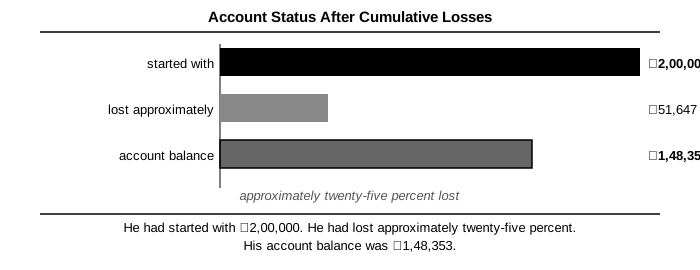
Across his whole trading history so far, he had lost ₹51,647. His account balance was ₹1,48,353. He had started with ₹2,00,000. He was down roughly twenty-five percent.
He set the stop loss and then, four minutes after entry, moved it down by ₹3 because the price was getting close. This wasn't the trade that cost him ₹11,400 --- this was a different trade, two weeks later, where he did it again. Same mistake, smaller scale. He would repeat this exact error three more times before he stopped. Each time, moving the stop cost him more than the original position size would have.
On Sunday he told KM Sir what had happened.
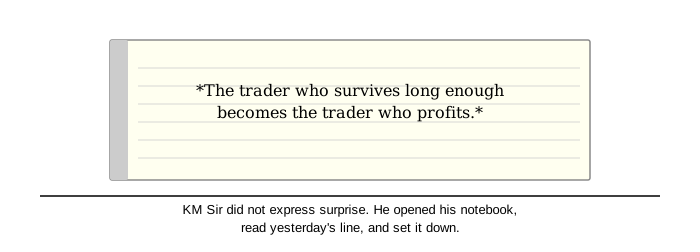
KM Sir didn't look surprised. He didn't say I told you so. He didn't offer comfort either. He opened his notebook, read yesterday's line, and set it down.
*The trader who survives long enough becomes the trader who profits.*
He asked: "Why did you not set a stop loss?"
"I thought I would watch it."
"And what happened when you watched it?"
"I didn't exit."
"Why?"
This was the harder question. Rohan actually thought about it. "Because exiting meant accepting that the trade was wrong. And I didn't want to be wrong."
KM Sir said nothing for a moment. Then: "This is the reason for a stop loss. Not to limit how much money you lose. To take away your ability to decide, in the moment, when to admit you were wrong. The stop loss makes that call before you can talk yourself out of it."
Risk management, as KM Sir explained it that morning, wasn't about being cautious. It was about staying in the game.
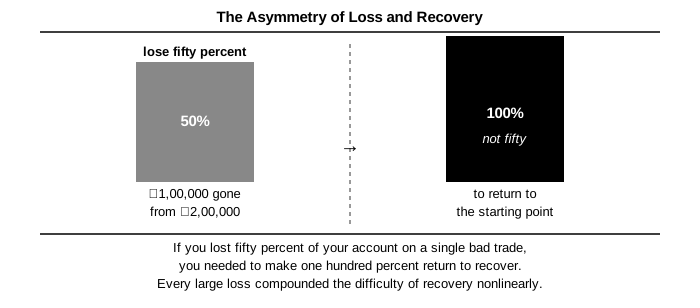
The math was simple. If you lost fifty percent of your account on one bad trade, you needed a hundred percent return to get back to even. Not fifty percent. A hundred. Because now you were starting from a much smaller base. Every large loss made recovery harder, and not in a straight line.
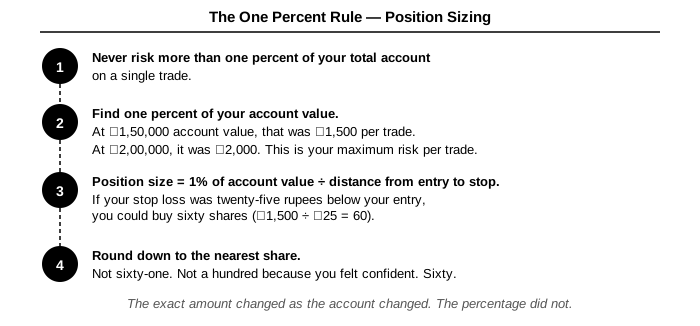
The rule KM Sir taught him was the one percent rule: never risk more than one percent of your total account on a single trade. At a ₹1,50,000 account, that was ₹1,500 per trade. At ₹2,00,000, it was ₹2,000. The rupee amount changed as the account changed. The percentage never did.
"At one percent per trade, you can lose fifty trades in a row and still have sixty percent of your account left," KM Sir said. "That's survivable. You can learn from fifty losing trades. You can't learn anything once your account is gone."
The position sizing that followed from the one percent rule was purely mechanical. If your account was ₹1,50,000, your risk per trade was ₹1,500. If your stop loss was twenty-five rupees below your entry, you could buy sixty shares (₹1,500 ÷ ₹25 = 60). Not sixty-one. Not a hundred because you felt confident. Sixty.
"This feels like a very small position," Rohan said.
"Yes. That's correct. Small positions keep you in the game long enough to learn. Large positions, taken out of context, just produce faster losses."
The risk-reward ratio went hand in hand with position sizing.
The rule: before entering any trade, your potential profit had to be at least twice your potential loss. If your stop was twenty-five rupees from entry, your target had to be at least fifty rupees from entry. A 1:2 risk-reward ratio.
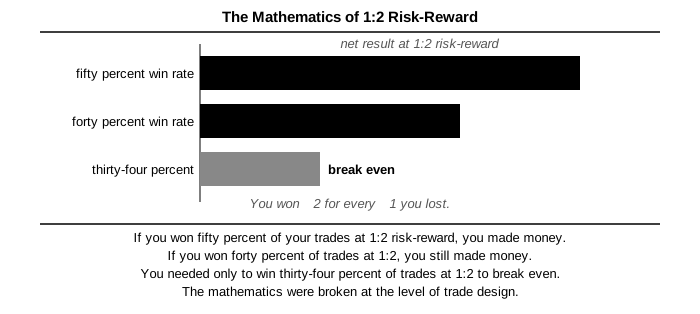
The reason was pure math. Win fifty percent of your trades at 1:2 risk-reward, and you make money --- you win ₹2 for every ₹1 you lose, and you win and lose equally often, so the net result is profit. Win just forty percent of trades at 1:2, and you still make money. You only need to win thirty-four percent of trades at 1:2 to break even.
Most traders, Rohan included, had been quietly taking trades at worse than 1:1 risk-reward --- risking more than they stood to gain --- and then losing more than half of those trades. You couldn't fix that outcome by getting better at entries. The math itself was broken, at the level of how the trade was designed.
"Before every trade, you calculate three things," KM Sir said. "Your entry. Your stop. Your target. If the target isn't at least twice as far from the entry as the stop, you don't take the trade. Not because the price definitely won't reach your target. Because you're not being paid enough to take the risk."
Rohan rebuilt his system that week, adding position sizing and risk-reward rules explicitly. His four rules became six:
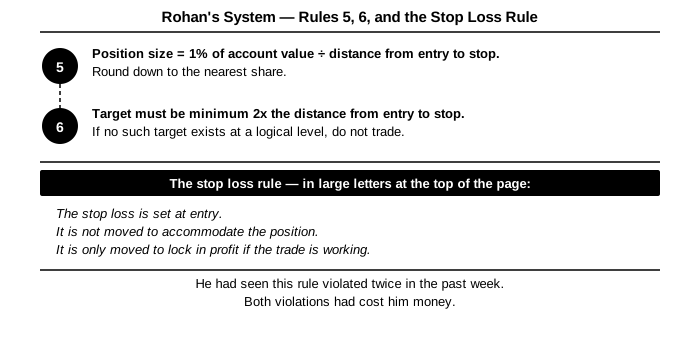
Rule 5: Position size = 1% of account value ÷ distance from entry to stop. Round down to the nearest share.
Rule 6: Target must be minimum 2x the distance from entry to stop. If no such target exists at a logical level, do not trade.
At the top of the page, in large letters, he also wrote: The stop loss is set at entry. It is not moved to accommodate the position. It is only moved to lock in profit if the trade is working.
He had watched this rule get broken twice in the past week --- once in the trade where he set a stop and then moved it down when price got close, and again when he watched the pharmaceutical stock trade with no stop at all. Both times, it cost him money.
Losing ₹11,400 in forty minutes was an expensive way to learn that a stop loss isn't a suggestion. But it taught the lesson clearly enough that he never repeated it in that exact form again.
He would repeat a smaller version of it twice more. He hadn't stopped being human. But he had stopped pretending that watching a trade in real time could replace a plan made before entering.
After this chapter, and for every trade for the rest of his life, he checked his account balance before entering. Not during. Before. He needed to know, before pressing the button, what one percent of his current account actually was. That habit didn't come from discipline alone. It came from the memory of watching ₹11,400 leave his account in forty minutes while he told himself it was just a pullback.
The memory did its job on its own. It didn't need maintaining. It was just there.
The math of position sizing turned out to be simpler than he expected, and more powerful than he had first believed.
He worked through it with real numbers from his account.
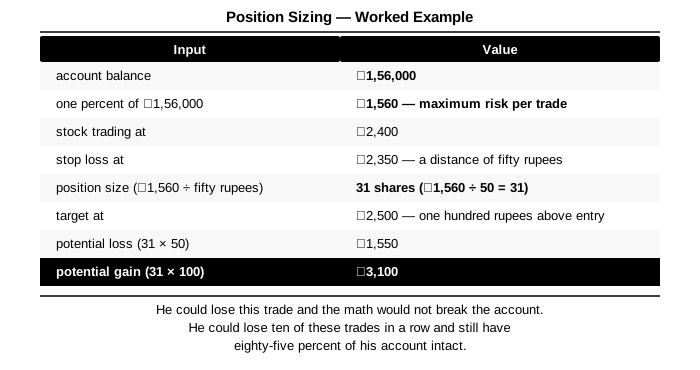
His account balance at the time was ₹1,56,000. One percent of that was ₹1,560 --- the most he was allowed to lose on any single trade.
If he found a setup on a stock trading at ₹2,400, with a stop loss at ₹2,350 --- a distance of fifty rupees --- his position size was: ₹1,560 divided by fifty rupees = 31 shares. He'd buy thirty-one shares. Not fifty. Not a hundred.
At thirty-one shares, if the trade stopped out at ₹2,350, his loss would be 31 × 50 = ₹1,550. Close to, but not over, one percent.
If he set his target at twice the stop distance --- ₹2,500, a hundred rupees above entry --- his potential gain on a winning trade was 31 × 100 = ₹3,100.
He could lose this trade and the math wouldn't dent the account. He could lose ten of these trades in a row and still have eighty-five percent of his account left. At his system's sixty-four percent win rate, he'd need ten straight losses to produce a run that long --- and the odds of that were roughly one in fifty-eight thousand.
This was the whole point of position sizing. Not to cap profit. To make losing bearable.
The reason most retail traders skip position sizing isn't that they've never heard of it. Most have read about it somewhere. The reason is that sized positions feel small. ₹1,560 at risk on a ₹1,56,000 account meant buying thirty-one shares, when the impulse was to buy two hundred.
Buying two hundred shares feels different from buying thirty-one. Two hundred shares meant a ₹50 move in your favour made ₹10,000 of profit. Thirty-one shares made ₹1,550 on the same move.
₹1,550 felt small. But ₹10,000 of potential profit was also ₹10,000 of potential loss, and ₹10,000 was six and a half percent of a ₹1,56,000 account. Four losses like that in a row would wipe out twenty-six percent of the account, needing a thirty-five percent gain just to get back to where he started.
The question wasn't which one felt better. It was which one survived.
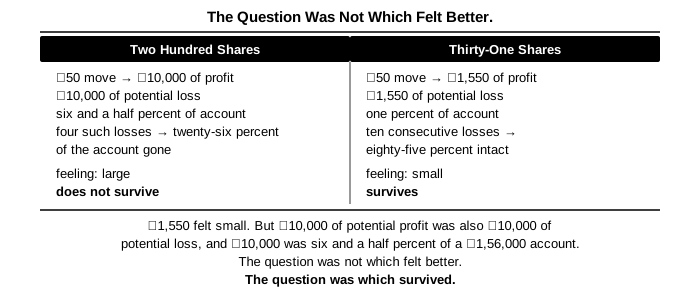
He had learned this the hard way in the ₹11,400 trade, where he took a position with no sizing at all and lost five percent of his account in forty minutes. The feeling during that trade had a specific texture: frozen. He watched the position move against him and couldn't make himself act. Part of that paralysis was simply the size of the trade. A ₹1,550 loss wouldn't have caused the same freeze, because ₹1,550 was already inside what he had decided, in advance, he could live with.
"Position sizing," KM Sir said, "is not a risk management tool. It is a decision-making tool. You make better decisions about trades you can afford to lose than about trades you cannot. A correctly sized position keeps the decision inside your emotional range."
Toward the end of this chapter, Rohan brought KM Sir an idea he'd read about in a trading book picked up at a second-hand bookshop in Andheri: R-multiples.
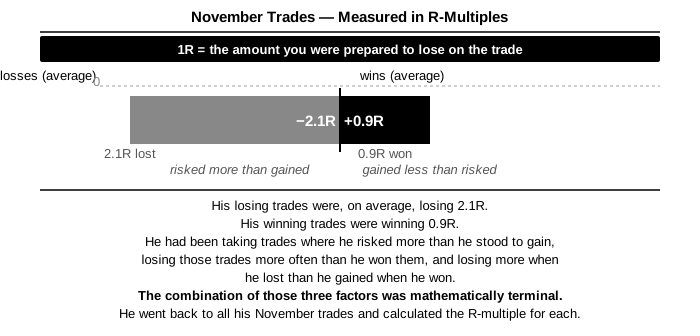
The idea was simple. Before any trade, you define your risk as 1R --- the amount you're prepared to lose. If your stop was ₹1,560 from entry, then 1R was ₹1,560. Win at a 1:2 target, and you've gained 2R. Lose, and you've lost 1R.
The advantage of measuring everything in R-multiples was that it let you compare trades with completely different position sizes and price levels. A trade where you risked ₹1,500 and made ₹3,000 was a 2R winner. A trade where you risked ₹2,000 and made ₹4,000 was also a 2R winner. In R-multiple terms, they were the same result --- which made comparing them meaningful.
He went back through all his November trades and worked out the R-multiple for each, using the stop distance as the denominator. The results were stark. His losing trades averaged 2.1R in losses. His winning trades averaged only 0.9R in gains. He had been risking more than he stood to gain, losing more often than he won, and losing bigger when he lost than he gained when he won.
Put those three things together, and the math was terminal.
After Chapter 9, this changed. He measured every trade in R-multiples. He required every entry to target at least 2R. He required every stop to be set before entry. He required position size to come directly from the 1R definition.
None of the mechanics were complicated. The hard part was applying them in real time, when the market was moving and the urge to jump in was strong.