The ₹40,000 Lesson
On the last Friday of October, Rohan Mehta stood in a bathroom stall on the third floor of his office in Andheri. He was reading his phone.
The screen showed ₹--40,247.
The number hadn't changed. He had checked it three minutes ago.
He put his phone in his pocket and went back to his desk.
Six weeks earlier, on a Saturday evening in September, Rohan was lying on his couch, scrolling through Instagram. He stopped on a screenshot.
It was from Vikram.
Vikram had been two years ahead of him in the CS department at their college in Pune. They weren't close friends. They were more like acquaintances --- the kind who like each other's posts and run into each other at wedding receptions. Vikram worked at a startup in Bengaluru. As far as Rohan knew, he wasn't good with money. In fact, he had failed Financial Management twice in second year.
The screenshot showed a Zerodha P&L page. ₹60,000 profit. A single trade. Three days.
The caption said: Markets > Salary.
Rohan stared at that number for a long time.
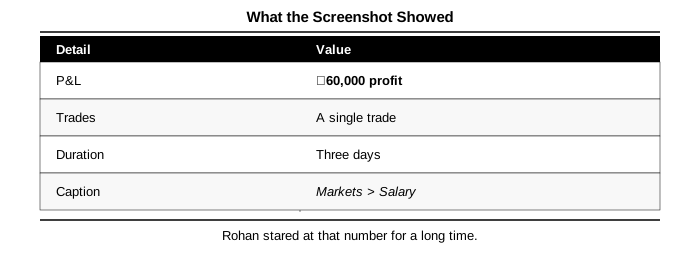
₹60,000 in three days. Rohan's monthly take-home pay was ₹1,15,000, after tax and EPF. In seventy-two hours, Vikram had made more than half a month's salary. And this was the same Vikram who had failed Financial Management twice.
He opened Zerodha's website that same evening.
The account took four days to open --- Aadhaar verification, bank linking, the CDSL process. He used the wait to do research. Looking back, it was exactly the wrong kind of research.
He watched fourteen YouTube videos with titles like How to Trade Stocks for Beginners and I Made ₹1 Lakh in One Month (Real Trading Strategy). He joined three Telegram groups. One posted Nifty levels. One was called Daily Calls India and had forty-seven thousand members. The third was one a college acquaintance had added him to without asking --- it sent four stock tips a day, each with a chart screenshot he couldn't read. He also downloaded a PDF called The 100-Point Trading System from someone's Google Drive link. He saved it to his phone and never read it.
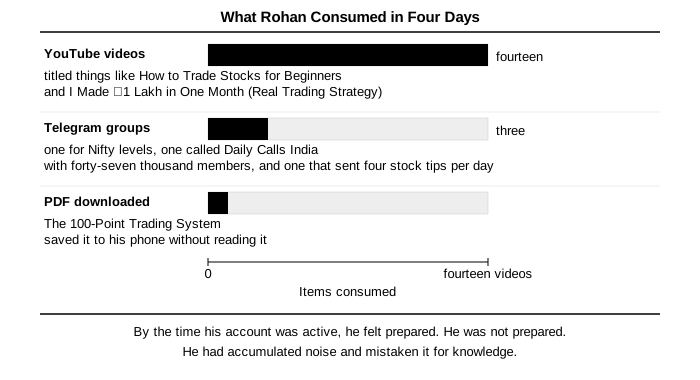
By the time his account was active, he felt ready. He wasn't. He had piled up noise and mistaken it for knowledge.
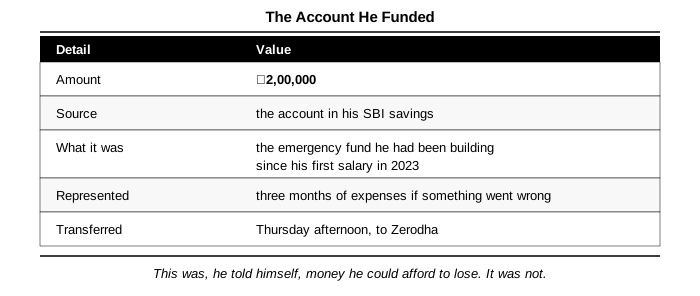
He funded the account with ₹2,00,000. He told himself this was money he could afford to lose. It wasn't. It was his emergency fund --- savings he had been building in his SBI account since his first salary in 2023. He had always thought of it as three months of expenses, just in case something went wrong. He moved the money to Zerodha on a Thursday afternoon, with the same confidence he brought to technical decisions at work. In other words, more confidence than the situation deserved.
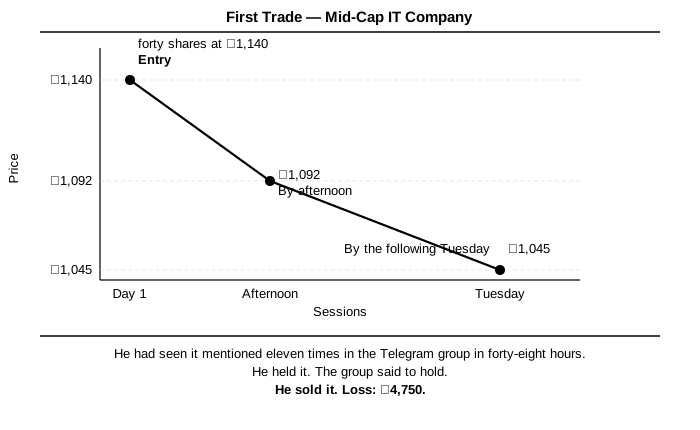
His first trade was a mid-cap IT company. He had seen it mentioned eleven times in the Telegram group in just forty-eight hours. The messages said it was about to break resistance and jump fifteen percent. Rohan didn't know what resistance meant. He bought forty shares at ₹1,140 --- the round number closest to what he saw on the chart.
By afternoon the stock was at ₹1,092.
He held on. The group said to hold. By the following Tuesday, the stock was at ₹1,045.
He sold it. Loss: ₹4,750.
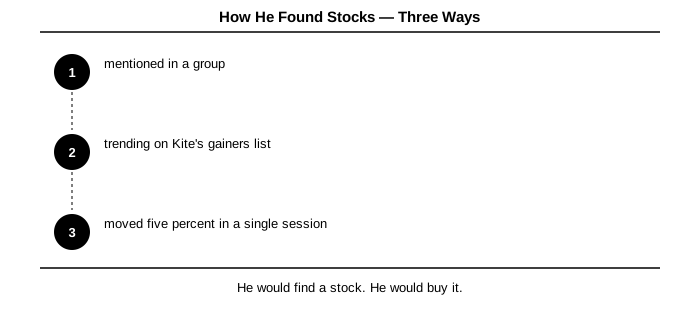
The next four weeks followed the same pattern. He would find a stock mentioned in a group, or spot it on Kite's gainers list, or notice it had moved five percent in a single session. He would buy it. Sometimes it went up for a while, and for a few hours he felt like he understood something. More often it drifted sideways, then quietly downward. He would hold on, because selling at a loss felt like admitting he'd been wrong. By the time he finally sold, the small loss had grown into a bigger one.
At no point did he understand why any of his trades went the way they did. That was the real problem. Not the size of the losses --- the not understanding.
He had lost ₹4,750 on his first trade and couldn't give a single reason why the stock had dropped. He had made ₹2,300 on a pharma stock and couldn't explain why it had risen either. The market was speaking a language he couldn't read. He was pressing buttons without understanding what any of them meant.
October's earnings season was especially costly. He bought a mid-cap IT company on the Wednesday before its quarterly results. He didn't know that the stock price already carried an expectation baked into it --- one he couldn't see. The company beat its estimates. Rohan expected the stock to jump. Instead it dropped eight percent in two hours. He later found an analyst note that explained it, though he didn't fully understand the note either: the results were good, but not as good as what institutional investors had already priced in. Rohan hadn't known that prices could be built on expectations. He hadn't known the idea even existed.
He lost ₹12,400 on that trade in two hours.
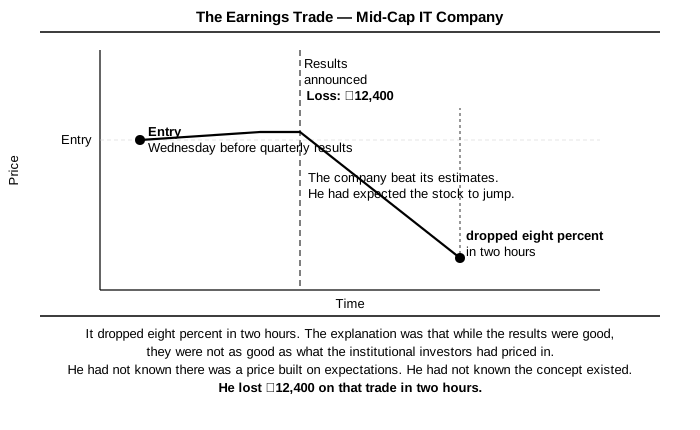
That trade broke something in the logic he had been using. He had done everything the Telegram group told him to. He bought before the results. The results were good. The stock fell anyway. His whole framework --- good news means the price goes up --- wasn't a framework at all. It was a guess dressed up as a rule.
At the morning standup, he had taken to opening a browser tab disguised as documentation --- he'd renamed the Kite tab Deployment Logs --- and checking his positions during sprint reviews. His PM asked him twice if he'd found a bug. He said he was verifying something in production. The truth was, he couldn't stop watching numbers he couldn't control and didn't understand.
His father called on Saturday morning, like he always did. Rohan was at the kitchen table in Malad, eating toast and trying not to look at his phone.
His father was a retired LIC agent from Pune. He had sold insurance for twenty-eight years. He believed in fixed deposits, PPF, and the post office savings scheme. About the stock market, he had no real opinion --- just a vague sense that it was something that happened to other people. Usually the wrong kind of people.
Rohan had not told him about Zerodha.
"You sound distracted," his father said.
"Just work," Rohan said.
After the call, he sat for a while looking out at the street. A chaiwala had set up his cart below. Traffic moved in the ordinary, slow way of a Mumbai Saturday. Nothing about the view had changed. Everything about his account balance had.
He sent a WhatsApp message to a number he had not contacted in two years.
Sir, this is Rohan. Rohan Mehta. You knew my father when he worked at Canara Bank in the nineties. I am in Mumbai now. I have been trying to learn to trade. I think I have been going about it completely wrong. Would you have time to meet?
Rohan had met Krishnamurthy Moorthy only once, at a family function in Pune when he was seventeen. He was a quiet man, retired from a bank, who had once said something Rohan hadn't fully understood at the time but had never forgotten: Most people treat the market like a lottery because they have never learned to read it. That sentence had stayed in the back of his mind for nine years, surfacing now and then without warning.
The reply came two hours later.
Sunday, 9am. Chembur. Bring your laptop.
That Saturday evening, he did something he hadn't done all month: he looked at his trade history properly.
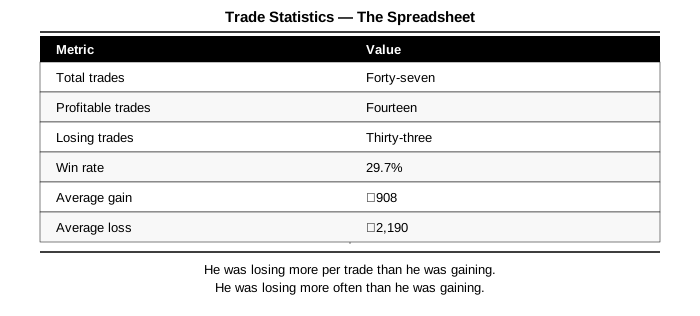
He opened the Zerodha console, went to the P&L report, and sorted every trade by date. Forty-seven trades. Fourteen profitable. Thirty-three losses. He had known the overall number was bad. He hadn't known the split was this bad.
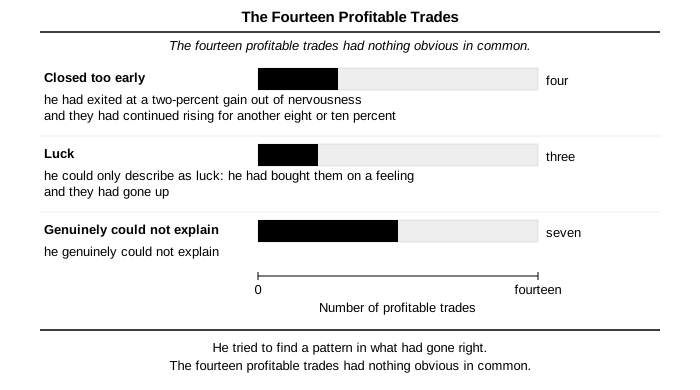
He tried to find a pattern in what had gone right. The fourteen winning trades had nothing obvious in common. Four were stocks he had closed too early --- he'd sold out of nervousness at a two-percent gain, and they went on to rise another eight or ten percent. Three, he could only call luck: he had bought on a feeling, and the stock had gone up. The remaining seven, he genuinely could not explain.
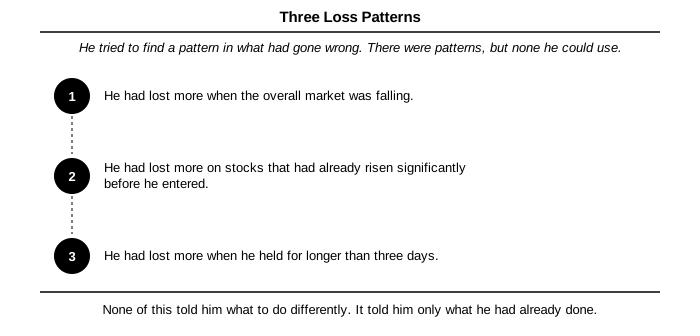
He tried to find a pattern in what had gone wrong. There were patterns, but none he could actually use. He lost more when the overall market was falling. He lost more on stocks that had already risen a lot before he bought in. He lost more when he held a position longer than three days. None of this told him what to do differently. It only told him what he had already done.
He built a spreadsheet with all forty-seven trades. He worked out his average loss (₹2,190) and his average gain (₹908). He worked out his win rate (29.7%). He stared at these numbers for a long time.
He lost more per trade than he gained. He lost more often than he gained. He was running a system --- if you could call it that --- where both how often he lost and how much he lost were worse than how often and how much he won. The math was simple. Keep going like this, and the outcome was the end of his account.
He fell asleep at his desk at 1:15am.
He woke up an hour later, his head resting on his forearm. The spreadsheet was still open on the screen. He looked at it for a moment, then closed the laptop and went to bed.
In the last few hours he had finally understood something he'd been avoiding all month: he wasn't trading. He was paying for an education he wasn't getting. Every loss had taken money out of his account and given him nothing back --- just a vague sense that he'd made a mistake. He couldn't even name the mistake clearly enough to avoid making it again.
Lying in the dark in his one-bedroom flat in Malad, there was one thing he was certain of: that certainty alone wasn't enough.
He set an alarm for 7:30am. Sunday. 9am. Chembur.
There's a kind of loss in trading that's worse than a big loss. It's a loss you can't explain.
Rohan had lost ₹40,247. He couldn't explain a single rupee of it in a way that would help him trade differently tomorrow. For every trade, all he could say was I bought it and it went down. That wasn't an explanation. It was just a description of a loss, with no cause attached.
A colleague at work, Arjun, played poker seriously --- online, sometimes in small cash games, occasionally in a weekend tournament at a flat in Bandra. Arjun had once told him that the worst thing a poker player could do was win with a bad hand. Losing with a bad hand was just a loss. But winning with a bad hand meant you got the right outcome from the wrong process --- and it taught you to repeat that wrong process.
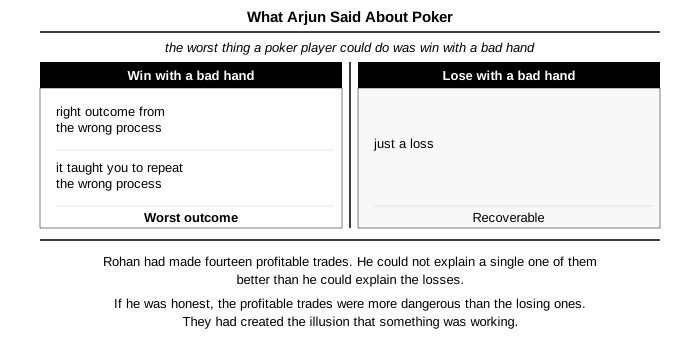
Rohan had been turning that sentence over for two days. He had made fourteen winning trades in his first month. He couldn't explain a single one of them any better than he could explain the losses. He had simply bought things that went up.
If he was honest, the winning trades were more dangerous than the losing ones. They created the illusion that something was working.
Nothing was working. He had been lucky fourteen times and unlucky thirty-three times, in a game whose rules he didn't understand.
What finally pushed him to send that WhatsApp to KM Sir wasn't the October earnings loss. It was something smaller.
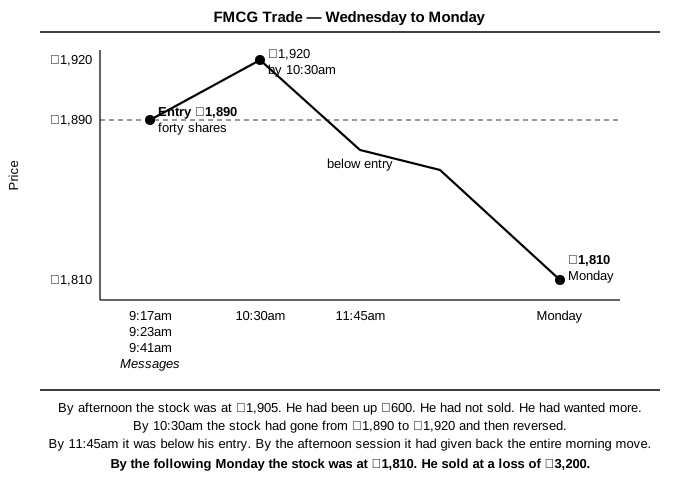
On the Wednesday of his fourth week, he traded an FMCG company because it had shown up in three separate Telegram messages that morning. He bought forty shares at ₹1,890. By afternoon the stock was at ₹1,905. He was up ₹600.
He didn't sell. He wanted more.
By the following Monday the stock was at ₹1,810. He sold at a loss of ₹3,200.
That evening, he went back and looked at the Telegram messages from that Wednesday. They'd come at 9:17am, 9:23am, and 9:41am. All three said the stock was about to break out. He scrolled forward to see what happened after he bought.
By 10:30am that Wednesday --- just over an hour after the messages --- the stock had climbed from ₹1,890 to ₹1,920, then reversed. By 11:45am, it was below his entry price. By the afternoon session, it had given back the entire morning's gains.
He checked the user who had sent two of the three messages. The account had been created eleven weeks earlier. In that time, it had sent 847 messages to the group --- all of them stock tips with price targets. Not one included an explanation of why the stock was actually a good trade.
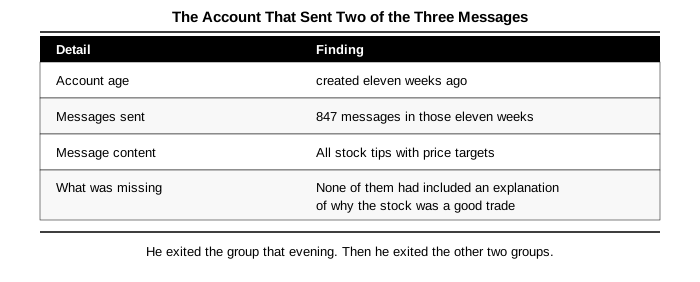
He left the group that evening. Then he left the other two groups. Then he deleted the PDF he'd downloaded in the first week. He didn't delete his Zerodha account, though he thought about it.
Instead, he sent the WhatsApp to KM Sir.
What he brought to that first Sunday meeting wasn't a list of questions. He had tried to write some down, but the questions he wanted to ask --- what stock should I buy? what indicator works best? when should I buy and when should I sell? --- all assumed the problem was a lack of information. He was starting to suspect the problem wasn't information at all.
He had read enough, watched enough videos, joined enough groups. He now had more information about financial markets than ever before. And less understanding than he'd had before he even started.
What he brought to the meeting was his laptop, as instructed, and a notebook he'd bought on Monday. In it, he had written two pages of observations from the past month. And he brought one question he couldn't stop asking himself --- a simple one: why is price doing what it is doing?
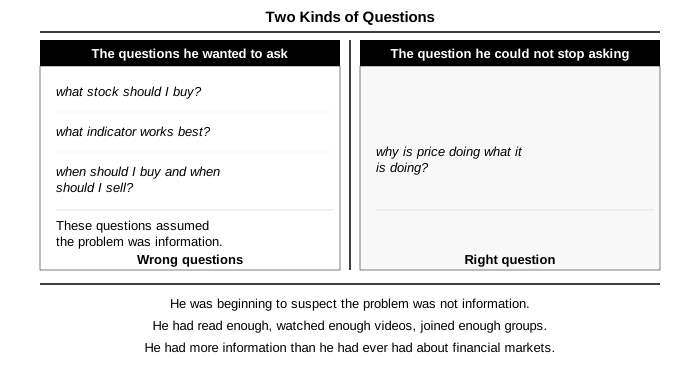
He didn't know yet that this was the right question. He would learn that in the next chapter.