Trends --- The Only Thing Worth Trading
One Sunday morning in late November, Rohan arrived at KM Sir's flat with a question he had been building up for a week.
"Should I be buying or selling right now?" he asked, before he had even sat down.
KM Sir was standing at the kitchen counter with his filter coffee. He looked at Rohan with the same expression he brought to most questions --- the look of someone deciding whether the question was worth answering, or worth replacing with a better one.
He set his coffee down. He picked up his notebook from the table, opened it to yesterday's page, read the line he had written the previous morning, closed it, and set it back down.
*Trading with the trend is not excitement. It is precision.*
Then he said: "What is the market doing?"
"That's what I'm asking," Rohan said.
"No. That's what I'm asking."
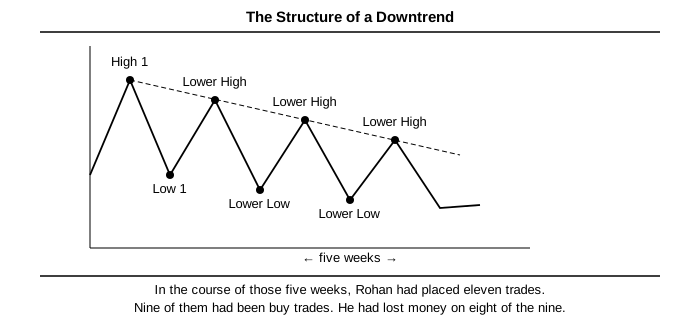
Once Rohan pulled up the chart and actually looked at it, the answer was clear: the Nifty 50 had been in a clear downtrend for five weeks. The high it made four weeks ago was lower than the high before it. The low it made three weeks ago was lower than the low before it. Lower highs. Lower lows.
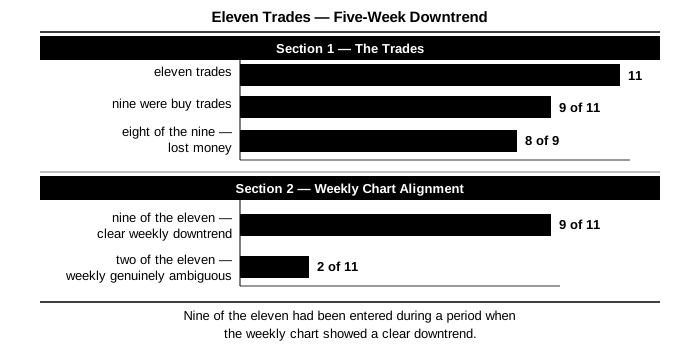
Over those five weeks, Rohan had placed eleven trades. Nine were buys. He had lost money on eight of the nine.
He had been buying in a downtrend. Not because he had studied the trend and chosen to go against it --- he hadn't looked at the trend at all. He had been looking at individual setups, a support level here, a candlestick pattern there, without ever asking the most basic question about the market he was trading in.
Which direction is it going?
"You have been bargain hunting," KM Sir said.
"What?"
"Every stock that dropped, you thought was cheap. Every level that held briefly, you thought was a bottom. You were buying things because they had fallen, not because the direction of the market gave you any reason to expect them to rise."
Rohan looked at his trade list. He had called it "oversold" seven times in three weeks --- and seven times it had gone lower.
KM Sir spent the next hour explaining how to identify a trend, starting with the only definition that actually matters in practice.
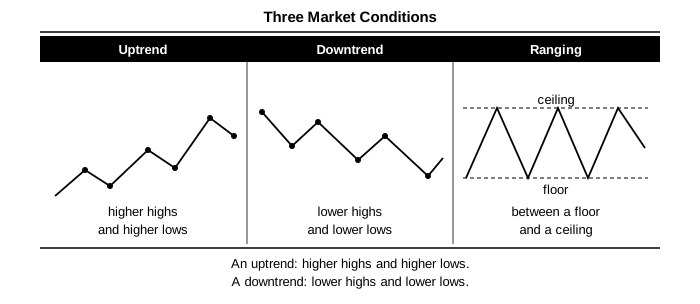
An uptrend: higher highs and higher lows. Each new peak in the price is higher than the last one. Each new trough is higher than the last one. The market is making net progress upward over time.
A downtrend: lower highs and lower lows. Each new peak is lower than the last one. Each new trough is lower than the last one. The market is making net progress downward over time.
A ranging market: neither pattern holds consistently. Price bounces between a floor and a ceiling without making real directional progress. Sometimes called sideways, sometimes called consolidation.
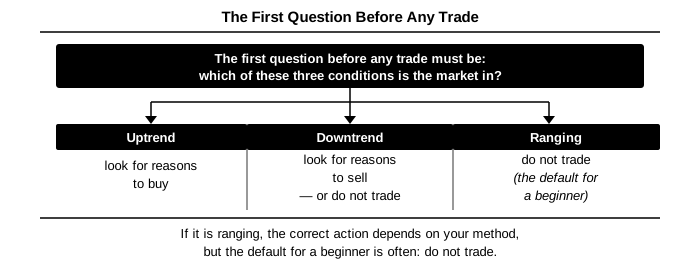
"The first question before any trade," KM Sir said, "has to be: which of these three conditions is the market in? If it's in an uptrend, you look for reasons to buy. If it's in a downtrend, you look for reasons to sell --- or you don't trade. If it's ranging, the right move depends on your method, but the default for a beginner is usually: don't trade."
"Why not trade in a range?"
"Because in a ranging market, stops are tight and moves are unpredictable. You'll get stopped out of good positions again and again. A ranging market is expensive for beginners. Experienced traders can manage it, with methods built specifically for ranging conditions. You're not there yet."
The thing Rohan had been getting wrong, without realizing it, had a name: trading with the trend.
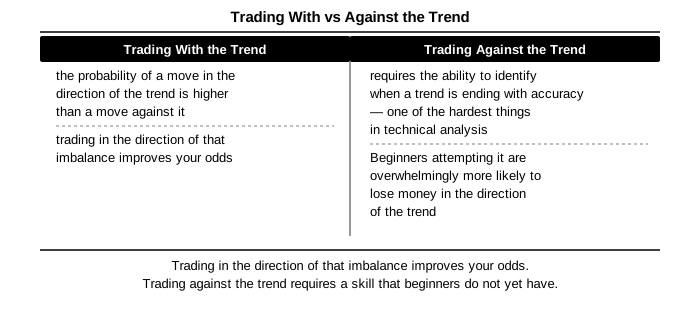
It's one of the oldest principles in technical analysis, and one of the most consistently ignored by retail traders. The logic isn't complicated: in a trending market, a move in the direction of the trend is more likely than a move against it. Not because trends last forever --- they don't. It's because while a trend lasts, it represents a real imbalance between buying and selling pressure. Trading in the direction of that imbalance improves your odds.
Trading against a trend --- trying to pick the bottom in a downtrend, or short the top in an uptrend --- takes a specific skill Rohan didn't have yet: spotting, with real accuracy, when a trend is actually ending. That's one of the hardest things in technical analysis. Experienced traders can do it with some consistency. Beginners who try it are far more likely to simply lose money in the direction of the trend, while believing they're making a clever contrarian play.
"The trend is your evidence," KM Sir said. "If you don't know what the trend is, you have no evidence for any trade. You're guessing."
Rohan thought about his nine losing trades over the past five weeks. He had called each one an opportunity. At the moment he entered, he had believed he had a reason.
He hadn't had a reason. He had had a hope.
There was one more thing in this lesson that cost him something to learn, and it cost him nothing in money.
Toward the end of the session, KM Sir asked: "What would you have done last week if you had known the market was in a downtrend?"
"I would have waited for a short opportunity," Rohan said.
"And if no clear short opportunity appeared?"
Rohan thought about it. "Nothing? Wait?"
"Yes."
This was harder than it sounded. By this point, Rohan had been checking the Kite app every morning and evening for almost two months. He had been looking for trades. What he was being asked to build was the discipline to look for trades, find none, and be fine with that.
Not trading wasn't inaction. It was a decision. In the right market conditions, the best trade was no trade.
He had lost ₹28,000 of his original ₹40,247 making trades he shouldn't have made. Some of that came from trading against the trend, in conditions that never supported his entries. If he had simply not traded during those five weeks --- if he had recognised the downtrend and waited --- his account would be down by far less.
The most expensive skill in trading, he was beginning to understand, wasn't knowing when to enter. It was knowing when not to.
He wrote this in his notebook and drew a line under it.
He didn't fully believe it yet. But he had written it down, and that was a start.
KM Sir used a phrase in this lesson that Rohan wrote down immediately and came back to for the rest of his trading life: the trend is your employer. You work in its direction or you do not work at all.
The point wasn't that trends were permanent. They ended. They reversed. Sometimes an experienced trader could see the reversal coming and trade against the old trend profitably. The point was that for a trader who didn't yet have the skill to spot trend endings accurately --- and that skill takes months of practice and a specific toolkit --- fighting the trend meant fighting the most powerful structural force in the market.
He had been doing exactly that for eleven trades without realizing it.
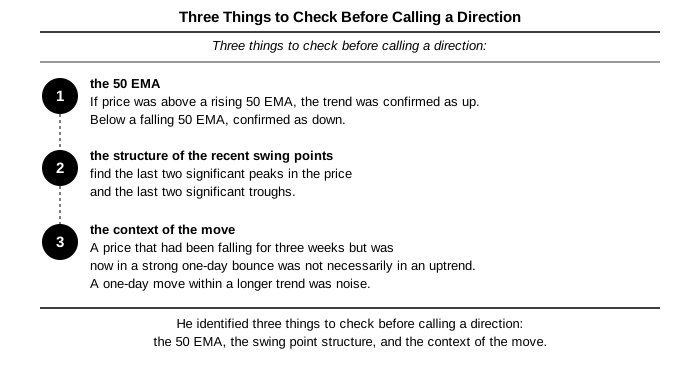
Beyond the basic definition of higher highs and higher lows, there were three practical things to check when identifying a trend.
The first was the 50 EMA, which he hadn't studied in detail yet (that came in Chapter 7), but which KM Sir mentioned as the tool he used to confirm what the price structure was already telling him. If price was above a rising 50 EMA, the trend was confirmed up. Below a falling 50 EMA, confirmed down.
The second was the structure of recent swing points. He had to find the last two significant peaks and the last two significant troughs in the price. Were the peaks higher or lower than each other? Were the troughs higher or lower? This told him, with no indicator at all, whether the market was actually making progress.
The third was the context of the move. A price that had been falling for three weeks but was now in a strong one-day bounce wasn't necessarily in an uptrend. A one-day move inside a longer trend was just noise. He had to look at the right timeframe to get the right answer.
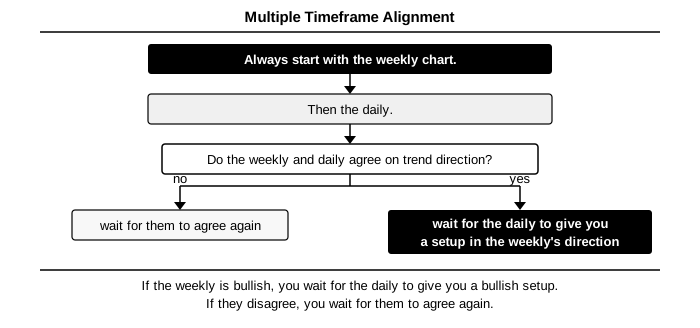
"Always start with the weekly chart," KM Sir said. "Then the daily. The weekly tells you the major trend. The daily tells you the medium trend. The two should agree before you trade. If the weekly is down and the daily is trying to bounce, you're looking at a correction inside a downtrend --- and corrections inside downtrends are usually short-lived."
He went back through his eleven losing trades in the downtrend and checked what each one had looked like on the weekly chart at the time he entered.
Nine of the eleven had been entered while the weekly chart showed a clear downtrend: lower weekly highs, lower weekly lows, price consistently below the weekly averages. He had been ignoring the weekly chart entirely --- making decisions off the daily chart without ever asking whether the daily was swimming with or against the weekly tide.
This was, he thought, like planning a cycling route without checking whether it was uphill or downhill.
Two of the eleven trades had been entered when the weekly chart was genuinely unclear --- the market was ranging at the weekly level. In those two, at least, his daily-level analysis had been operating in a neutral context. Both had been smaller losses than the rest.
The pattern wasn't perfect. But it was clear enough to act on.
"Multiple timeframe alignment," he said to KM Sir. "The weekly and daily need to agree."
"Yes. And the setup needs to show up on the daily once you've confirmed the weekly. If the weekly is bullish, you wait for the daily to give you a bullish setup. If the weekly is bearish, you wait for the daily to give you a bearish setup. If they disagree, you wait for them to agree again."
"And if I'm waiting and the market moves without me?"
"Then the market moves without you. This will happen often. There will always be moves you don't take part in because the conditions weren't clear. That's not a failure. The failure is entering unclear conditions and losing money. Every trade you don't take that would have lost money is a win."
He wrote this down. He didn't believe it yet, not completely. Treating "not trading" as a win meant redefining success in a way he wasn't fully ready to accept.
He would be ready by Chapter 9.