Your First Trading Checklist
On the last Sunday of December, KM Sir put something on the table that Rohan hadn't seen before.
It was a single page, cut from a larger sheet, with a list printed on it in small font. The page was slightly yellowed at the edges, with a coffee ring in the lower left corner that had been there long enough to feel like part of the document rather than an accident.
"My trading checklist," KM Sir said. "I wrote it in 2018. I have not changed it since."
Rohan looked at it. Seven numbered questions. Each one short. None with multiple parts.
He read them in order. Three of the seven were things he was already checking. Two were things he hadn't thought of explicitly, but which made instant sense. One he would only fully understand after three months of using it. The seventh --- Have I reviewed this week's trades? --- he didn't understand the point of at all yet.
"This is not my system," KM Sir said. "The system tells me what signals to look for. The checklist tells me whether I've checked everything before I act. They're different jobs."
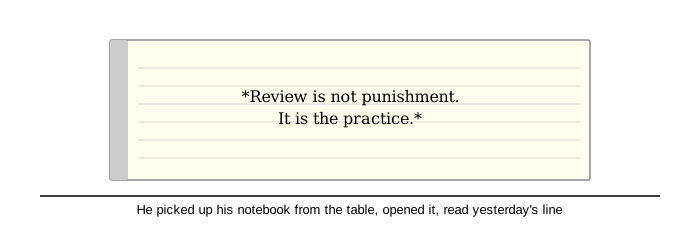
He picked up his notebook from the table, opened it, read yesterday's line carefully, and closed it.
*Review is not punishment. It is the practice.*
They spent the morning building Rohan's own checklist.
The process wasn't complicated, but it required Rohan to be honest about what he had been skipping and what he had been doing right. KM Sir asked him to walk through his last five trades, one by one, and for each say what he had checked before entering and what he hadn't.
The exercise was uncomfortable. On two of the five trades he had followed all six rules. On one, he had entered without checking volume. On one, he had moved the stop loss after entry. On one --- the pharmaceutical trade --- he had broken Rules 1, 2, and the stop loss requirement all at once.
"A checklist is useful precisely because the human mind skips steps under pressure," KM Sir said. "When a trade looks right to you, you feel pressure to enter before the opportunity passes. In that state, you skip the steps meant to protect you. The checklist makes the skipping obvious instead of invisible."
He continued: "If you skip a step on a checklist, you know you've skipped it. You can't pretend otherwise. You can still choose to trade without finishing the checklist. But then you can't call it a system-based trade. You're making a discretionary decision, and you should be honest with yourself about that."
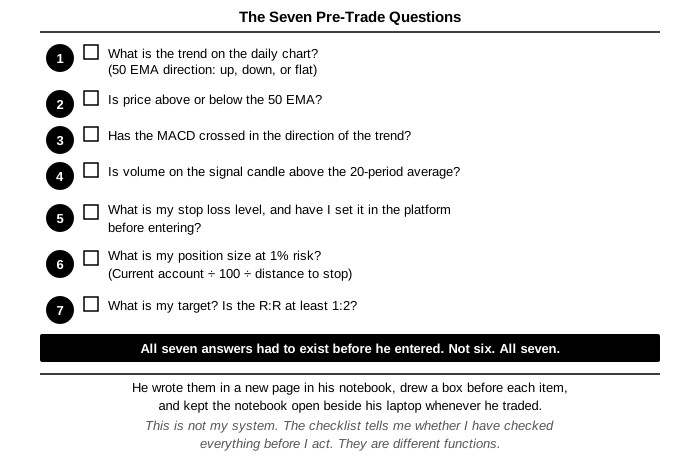
Rohan's checklist had seven items. He wrote them on a new page in his notebook, drew a box before each one, and kept the notebook open beside his laptop whenever he traded.
The seven questions:
1. What is the trend on the daily chart? (50 EMA direction: up, down, or flat)
2. Is price above or below the 50 EMA?
3. Has the MACD crossed in the direction of the trend?
4. Is volume on the signal candle above the 20-period average?
5. What is my stop loss level, and have I set it in the platform before entering?
6. What is my position size at 1% risk? (Current account ÷ 100 ÷ distance to stop)
7. What is my target? Is the R:R at least 1:2?
All seven answers had to be in place before he entered. Not six. Not seven minus the one that felt uncomfortable. All seven.
KM Sir added one more thing once they had finished the checklist: the Sunday Review.
This was something he had done every Sunday morning for eleven years. Not for motivation. Not for planning. For measurement.
Every Sunday, for twenty minutes, he looked at the trades from the previous week. For each one, he asked three questions: Did I follow the checklist? If not, what did I skip? And what was the outcome?
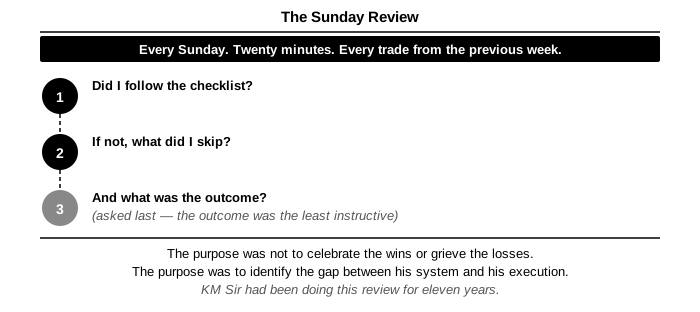
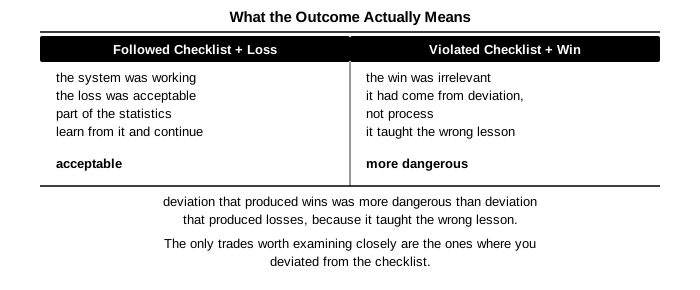
The point wasn't to celebrate wins or mourn losses. It was to find the gap between his system and his execution. If he had followed the system and still lost, the system was working and the loss was acceptable. If he had broken the system and won, the win didn't matter --- it came from deviation, not process, and deviation that produced wins was more dangerous than deviation that produced losses, because it taught him the wrong lesson.
"The only trades worth examining closely are the ones where you strayed from the checklist," KM Sir said. "Not the ones where you followed the system and lost --- those are just part of the statistics. The ones where you strayed, whether you won or lost, are the ones that tell you what your real tendencies are."
Rohan built a simple spreadsheet that evening. Date. Entry. Stop. Target. Actual exit. Followed checklist: yes or no. If no, which item he'd skipped. Net P&L. He went back through his past trades and filled it all in.
The pattern jumped out immediately: every significant loss had been preceded by a checklist violation.
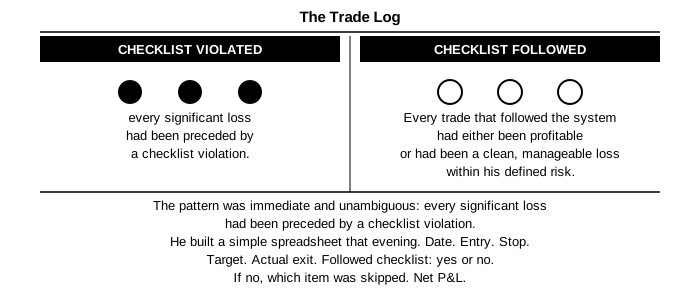
Every trade that followed the system had either been profitable, or had been a clean, manageable loss within his defined risk.
He stared at this data for a long time.
The last week of December was Rohan's first profitable month.
Not by much. His net P&L for the month was +₹12,840. His win rate across all system-based trades in December was fifty-one percent. His average risk-reward was 1:2.1. The math had worked, barely, in his favour.
His Zerodha console at the end of the month showed a total P&L since he opened the account of ₹--38,807. He had started with ₹2,00,000, lost ₹40,247 in month one, and spent the following two months slowly, imperfectly, clawing back.
He hadn't recovered the full ₹40,247. He wouldn't recover it this month, or the next. That money was gone. What remained was the process, and the process was starting to work.
He opened his notebook to the very first page he had written, six weeks earlier: 47 trades. 14 profitable. 33 losses. Average loss: ₹2,190. Average gain: ₹908.
December's numbers were: 22 trades. 11 profitable. 11 losses. Average loss: ₹1,480. Average gain: ₹3,050.
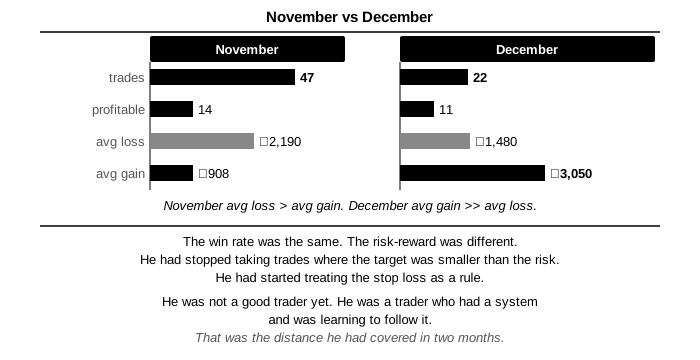
The win rate was basically unchanged. The risk-reward wasn't. He had stopped taking trades where the target was smaller than the risk. He had started treating the stop loss as a rule, not a suggestion.
He wasn't a good trader yet. He was a trader who had a system and was learning to follow it. That was the distance he had covered in two months. He didn't know yet how much distance was left.
He sent KM Sir the December P&L screenshot on New Year's Eve.
KM Sir replied three hours later with four words: Good. Keep the log.
Rohan looked at the message for a while. He had half-expected something more --- some nod to the progress, some marker that one phase had ended and another had begun.
It didn't come.
On the first Sunday of January, he arrived at KM Sir's flat at 9am as usual. KM Sir had his filter coffee. He had his notebook. He read yesterday's line before speaking, like he always did.
He didn't mention the P&L. He asked Rohan to show him the last five trades.
Rohan opened his spreadsheet and his charts.
This was the lesson: the process didn't pause for milestones. There was no ceremony. There was only the next trade, and whether he had followed the checklist before taking it.
KM Sir looked at the trades. He made two observations. He asked three questions. He closed his notebook.
The filter coffee sat on the table between them.
The clarity Rohan had found wasn't the certainty he had wanted. He had wanted a system that told him, in advance, what would work. What he had found was a system that told him, after the fact, whether he had done the right thing. The difference between those two was smaller than he'd expected, and bigger than he'd understood.
He picked up his pen and opened his notebook.
He had eight more books to read.
The Sunday Review was the ritual he had resisted the most, and ended up adopting the most fully.
In the early weeks, he had treated each trading day as its own separate event. A loss on Monday didn't shape his approach on Tuesday. A win on Wednesday didn't carry a lesson into Thursday. He was reacting, not learning. Every session started from zero. Nothing built up.
The Sunday Review changed that by forcing a whole week of trades into one single look-back.
The format was simple: he opened the spreadsheet, pulled up the charts for every trade he had taken that week, and asked the same three questions for each one. Did I follow the checklist? If not, what exactly did I skip? And what was the outcome?
The outcome question came last because it was the least useful one. A trade that followed the checklist and lost wasn't a failure. It was just the cost of doing business in a probabilistic system. A trade that broke the checklist and won wasn't a success. It was a mistake in disguise, one that would reinforce a bad habit.
He hadn't understood this distinction before building the review. He had understood it intellectually --- the way most things in trading can be understood in theory long before they're understood in the gut. The review made it real. When he compared a trade that broke the checklist and lost ₹3,000 to a trade that followed the checklist and lost ₹1,480, the numbers made the case for him.
KM Sir had been running this review for eleven years.
One Sunday, without warning, he showed Rohan a notebook from 2019. He opened it to a specific page --- not a market-observation page, but a review page. A weekly summary in four columns: trade number, checklist followed, R-multiple, note.
The 2019 page showed a week with six trades. Three had followed the checklist. Two had deviated on one item. One had been taken completely outside the system. Both deviation trades had lost. The off-system trade had won.
"This," KM Sir said, pointing at the off-system trade that had won, "was the most dangerous trade of that week. It won. So the next week I was tempted to take another one like it. I did. It lost. The win in week one was random. The loss in week two was predictable."
"How did you know the win was random?" Rohan asked.
"Because I couldn't write the conditions that produced it as rules. I had entered because something 'looked right.' If I can't say specifically what looked right, in terms clear enough to repeat, then I didn't have a reason. I had a feeling. Feelings don't repeat. Rules do."
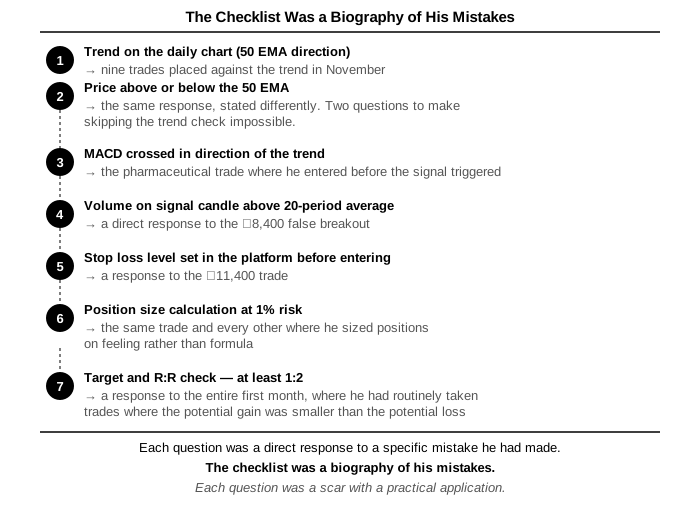
The seven questions on Rohan's checklist hadn't been picked at random. He had built them out of six weeks with KM Sir and the month of trading before that. Each question was a direct answer to a specific mistake he'd made.
Question 1 --- the trend on the daily chart --- answered the nine trades he had placed against the trend in November, without knowing the trend was down.
Question 2 --- price relative to the 50 EMA --- was the same answer, worded differently. Two questions, so skipping the trend check became impossible.
Question 3 --- the MACD crossover --- answered the pharmaceutical trade, where he had entered before the signal even triggered.
Question 4 --- volume confirmation --- answered the ₹8,400 false breakout directly.
Question 5 --- the stop loss level set before entry --- answered the ₹11,400 trade.
Question 6 --- position size calculation --- answered that same trade, and every other trade where he had sized positions by feeling instead of formula.
Question 7 --- the target and R:R check --- answered his entire first month, where he had routinely taken trades with a smaller potential gain than potential loss.
The checklist was a biography of his mistakes. Each question was a scar with a practical use.
In the last week of December, on the Thursday before New Year, Rohan placed the final trade he would count as part of Book 1.
It was a long trade on a large-cap banking stock. He went through the checklist in order. All seven answers were clear. He entered at the market open, set the stop, set the target, worked out the position size.
The trade hit its target on Friday afternoon, the last trading day of the year.
He closed the trade. He logged it in the spreadsheet. He noted that all seven checklist items had been met. He worked out the R-multiple: a 2.1R winner.
He closed the laptop.
He had been trading for three months. He had lost ₹40,247 in the first. He had lost more in the second, while building the system. He had made ₹12,840 in the third.
His overall position was still negative. He wasn't yet a profitable trader across his whole career. But for the first time, the number on the Zerodha screen represented something other than the pile-up of his mistakes. It represented the gap between where he started and where a process had taken him.
He looked at the number for a moment.
He didn't delete the Zerodha app before heading home to Pune for the new year. He didn't hide his phone when his father called. He didn't answer the question that wasn't asked, because it wasn't asked.
He wasn't there yet. He knew that.
But he was somewhere he had never been before: following a system he had built and understood, checking a list written from his own mistakes, and reviewing his results honestly enough to see what they actually were, not what he wished they were.
The clarity he had found wasn't the certainty he'd wanted. But it was something more reliable: a direction he could follow even when certainty wasn't there.
That was what Book 1 had cost him, and what it had given him.
In January, he would begin Book 2.
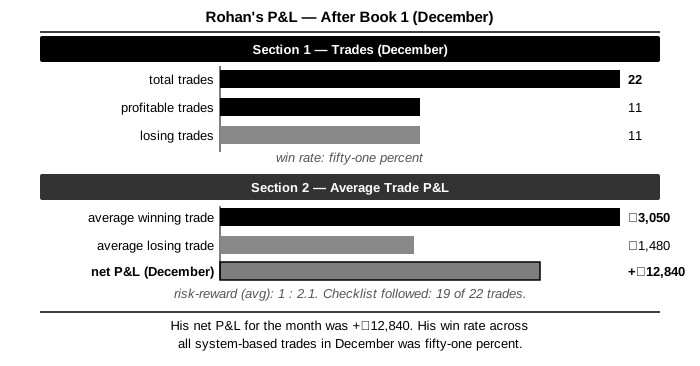
Rohan's P&L --- After Book 1
Total trades (Dec)............ 22
Profitable trades............. 11 (50.0%)
Losing trades................. 11 (50.0%)
Net P&L (December)............ +₹12,840
Average winning trade......... ₹3,050
Average losing trade.......... ₹1,480
Risk-reward (avg)............. 1 : 2.1
Checklist followed............ 19 of 22 trades
He had not recovered the ₹40,247. He had built the process that would.
Book 2: The Confident Reader
Patterns, Context, and Your First Backtested Edge.
Available on Amazon KDP.